Vitamin D and Breastfeeding
Myths Busted
Vitamin D and Breastfeeding SHOULD be one of the hottest topics in women's health today, but this INCREDIBLY important subject is being almost completely overlooked by doctors- which could have disastrous results with lifelong consequences for you and your baby if you do not address your needs for this VITAL nutrient. Despite the thousands of research studies that have been done, and despite the cries by vitamin D researchers to urge higher vitamin d intakes, doctors still don't address the need for higher vitamin D levels in pregnancy and breastfeeding. Instead, they still promulgate a myth that breastfeeding doesn't give the baby any Vitamin D. Keep reading, and we'll show you that this myth was busted long ago.
"The sooner physicians and other health professionals
become aware...of the value of adequate
vitamin D status, the sooner the incidence of new
cases of cancer and other serious illnesses may be reduced"
Cedric F. Garland, Dr. P.H. F.A.C.E.
Professor, Dept Family and Preventive Medicine
Member, UCSD Moores Cancer Center
University of California San Diego
Why Should You Care about
Vitamin D and Breastfeeding?
Well, Vitamin D is being shown more and more to be a factor in lifelong health. Vitamin D is important to prevent future problems for your child. Even in the womb, not getting enough Vitamin D During Pregnancy has lead been connected to later incidence of osteoporosis, dental enamel defects and even schizophrenia! And while most of us believe that we and our children are all getting plenty of Vitamin D, the soft bone disease of Rickets is Back and in numbers that doctors have never seen in their entire careers.
And part of the reason that rickets is back is the rise in concerned mothers who are breastfeeding their children exclusively and for longer periods of time.
Doesn't Breastfeeding Give Your Baby
Everything They Need?
While exclusive breastfeeding is AMAZING, your baby can only get what you have, and studies are showing that up to 85% of the population is vitamin d deficient- even supposedly 'healthy' pregnant and lactating women. If you think that because you've been taking your multivitamin and drinking milk every day that you have plenty of Vitamin D for you and your baby- you'd be Completely Wrong!!
In fact, after taking your multivitamin for 9 months and drinking milk every day, you are likely to still be SEVERELY DEFICIENT unless you regularly sunbathed during pregnancy!
When you read the Vitamin D Requirements page, you'll see that the AVERAGE non-pregnant person needs, according to researchers, between 3800 to 5000 IU's per day!! So, your 800 IU mulitivitamin and two glasses of milk is about ONE FOURTH of what the 'average' person needs. But as you'll soon see, you may need almost double that in order to get enough vitamin d in your breastmilk to meet you and your baby's Vitamin D and Breastfeeding needs!
Myth Busted- Does Breastmilk
Contain Vitamin D, or Not?
Researchers recommend that infants get between 200 to 400 IU's of vitamin d per day in order to prevent rickets. But breastmilk from mothers with no supplementation or inadequate supplementation have about
20 to 80 IU's of Vitamin D per LITER of breast milk. This is FAR FAR too low to even be preventing RICKETS, let alone getting your baby enough to prevent the Vitamin D Deficiency Symptoms that you AND your baby will be headed for if you don't get enough Vitamin D.
But breastmilk is actually an EXTREMELY RICH source of Vitamin D when you get enough Vitamin D! In fact, it's a GREAT source, producing up to between 500 to 800 IU's per liter. Now THAT is enough vitamin d to meet your baby's Vitamin D Requirements! But it takes a LOT of Vitamin d in order to meet your baby's requirements…
How Much Vitamin D Do You Need?
With Vitamin D and Breastfeeding, this subject has been studied quite in-depth. Breastfeeding mothers have been given supplements at different dosages and had their breast milk analyzed for the amount of vitamin D in it. I've summarized the research in the chart below:
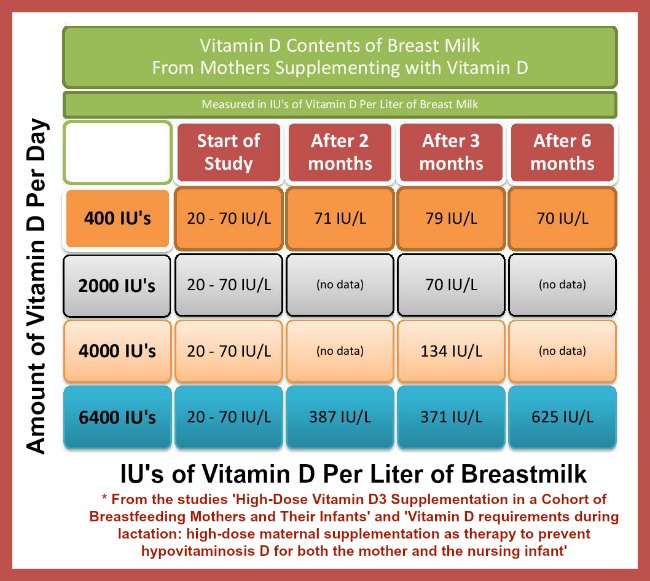
As you can see, you need to take AT LEAST 4000 IU's per day in order to get your baby barely 100 IU's per day of Vitamin D strictly through breast milk- barely enough to ward off rickets and FAR from the RDA requirements of 400 IU's per day. So, it appears that the only dose of Vitamin D that gave babies enough vitamin d to meet their RDA daily requirements was the group that received 6400 IU's per day.
And this dose was safe with zero cases of Overdose on Vitamin D and no adverse reactions in the babies.
Why Not Just Supplement Your Baby?
For the Vitamin D and Breastfeeding question, that is one way to go about it and to make sure that your baby gets the RDA of Vitamin D, but what about YOU? If you ignore your Vitamin D Requirements or simply take the RDA of 600 IU's for adults, then you could end up like the women in This Study who lost significant bone mass during lactation.
And since there is a strong correlation between Vitamin D and bone mass, and that sufficient vitamin d levels help to absorb calcium, and that Vitamin D and Breastfeeding needs high levels of Vitamin D to get enough vitamin D to meet a baby's needs, it simply makes sense that if YOU take enough Vitamin D in order to adequately provide for your baby, that you will be less likely to have so much calcium loss during your lactation that you put yourself at risk for decreased bone density later in life.
Even better yet, you could get a Vitamin D Level drawn, as most Vitamin D Researchers recommend, and make sure that you keep your Vitamin D Level within the 'Optimal' range... instead of the too low 'Normal' range that is on most laboratory sheets. Keep reading to find out what that 'Optimal' vitamin d range is... and what THAT has to do with Breast Cancer...
Next --->
Breast Cancer and Vitamin D
See Already Answered Questions about Vitamin D
Click below to see Questions About Vitamin D from other visitors to this page...
Hypercalcemia in infant caused by too much vitamin d through breastmilk
My 5 month old son was recently diagnosed with Hypercalcemia. I am on a 3 month waiting list to have him seen by a pediatric endocrinologist at. Children's …
Pregnancy and Taking Vitamin D3 While Breastfeeding
I have been taking 5000 iu of d3 for a year before I got pregnant and took it my whole pregnancy. Should that have been enough for my baby? I'm taking …
Breastfeeding 7 Month old and vitamin D
I am currently breastfeeding my 7 month baby. I had my vitamin d checked when he was 3 months and the level came back as 12. The doctor put me on a high …
Getting Enough Vitamin D in Breast Milk
I have been researching Vitamin D online for a while as I am very worried about my newborn baby. Prior to trying to conceive I was taking 10,000 IUs for …
100,000iu dosage a week and still nursing??
Prescribed 50,000iu's 2x a week...supplemental nusing 2-3 times a day...
Do not want to take this much...scared of toxicity for me and my son. Please …
Vitamin D for Infant & Mother?
Im breastfeeding my 9 month old baby. Should i take vitamin D supplements AND give her the liquid vitamin D? If we both take it, will it be too much …
Can I lose significant Vitamin D from making babies and breastfeeding?
I am a 44 y.o. mother of two boys: 7 & 5. I took pre-natals during pregnancy and while breastfeeding. I breastfed both kids for 2+ years. The first into …
Breastfeeding and Vitamin D
I stumbled across your site while researching the safety of Vitamin D and Breastfeeding . I was recently diagnosed with hypothyroidism which is now …
Vitamin D and Pregnancy
I have chronic Vitamin D deficiency. For the past year I have taken all kinds of supplements and have not been able to get it higher than 20. I have …
Vitamin D and Breastmilk
I want to up my Vitamin D intake to protect from the flu, but I am breastfeeding my 8 mo old daughter.
Can she receive too much Vitamin D through …
Research for Vitamin D and Breastfeeding
Back to Top of Vitamin D and Breastfeeding
To Easy Immune System Health Home